
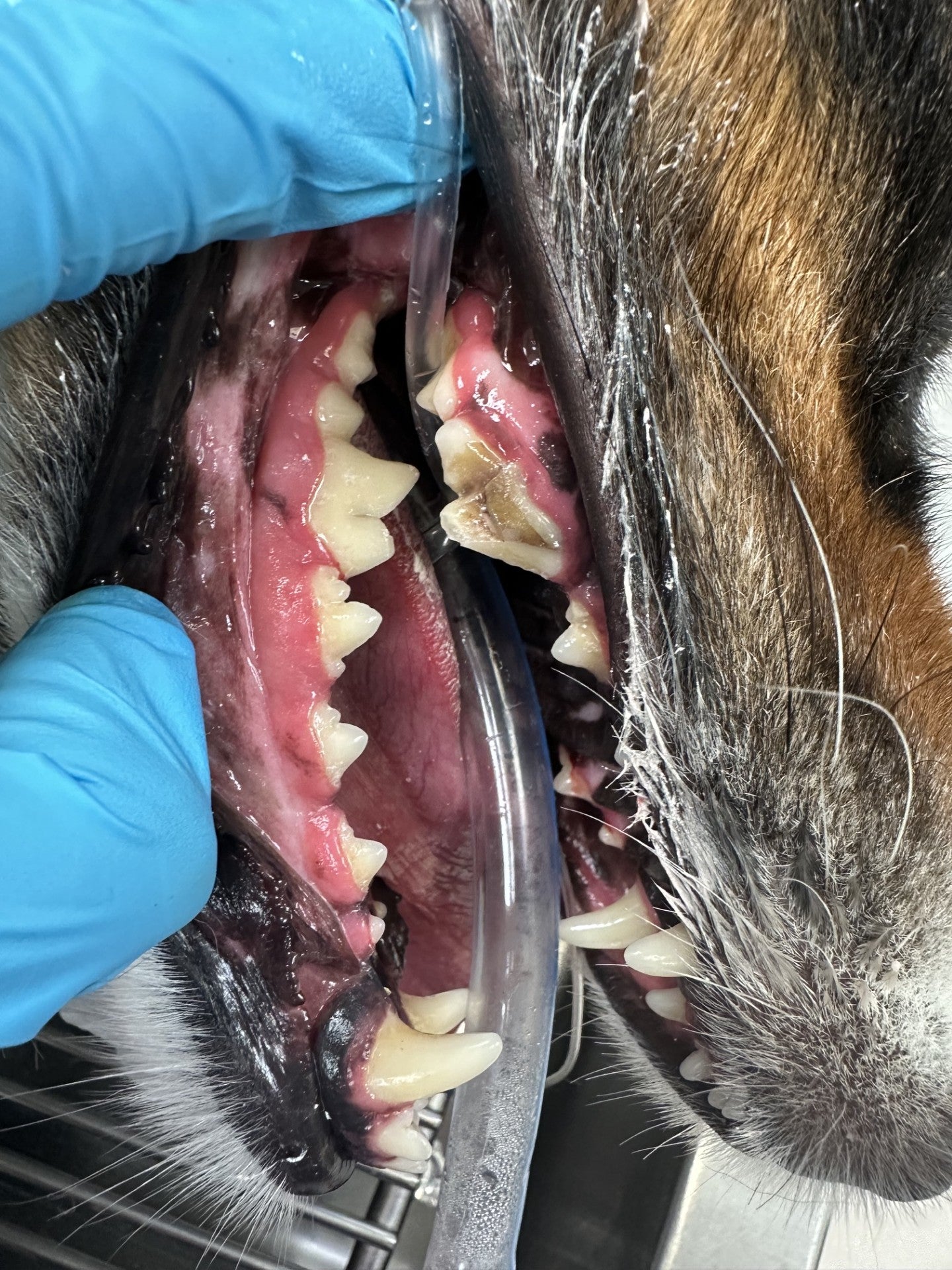
 Meet Peanut, an 8-year-old Mini Aussie who came to us with a broken tooth.
Presenting Problem: Peanut's owner noticed that she had one tooth with a large amount of tartar on it.
History: Peanut came to us after her owner was looking at her teeth and noticed one tooth had much more tartar on it than the rest of her teeth. She was not showing any signs of discomfort – her eating/drinking/playing with toys/energy was all normal. She eats Hill's Sensitive Skin and Stomach kibble and does have access to hard chews.
Physical Exam: Peanut's heart sounded perfect, she had recently lost weight after starting on a diet and was comfortable when her belly was palpated. In her mouth she had a small amount of gingivitis and tartar on all her teeth. On the upper right side, her big chewing tooth had a large accumulation of tartar, and we found that she had fractured that tooth! She had a portion of the tooth that was becoming disconnected and was extending up under her gums. On closer inspection it did look like the pulp canal (inner portion) was involved.
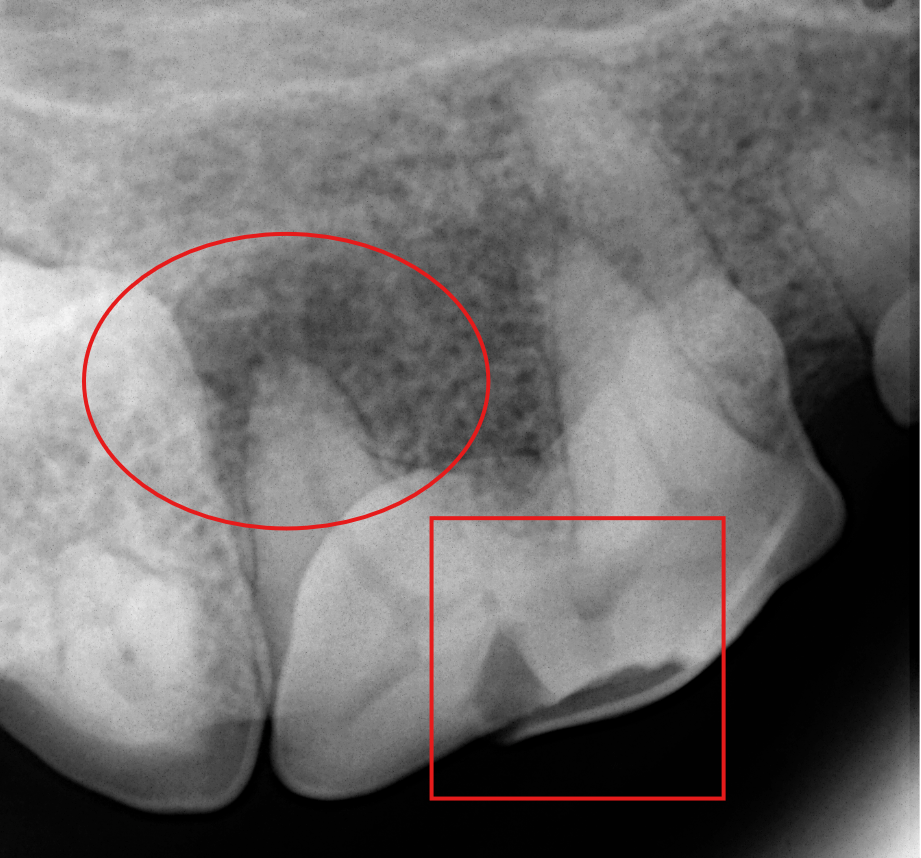
The tooth's fracture is in the square, and the circle indicates the infection at the root of the tooth.
What are some of the options for Peanut's tooth?
- Extraction
- Root Canal
- Do nothing
Answer: 1 and 2
Due to the fracture on Peanut's tooth, it was recommended to fully evaluate that tooth and the rest of her mouth under anesthesia. While under she had a thorough oral exam including radiographs of her teeth. We found that the fracture did involve the pulp canal and, on the radiographs, the exposed canal was showing signs of infection! The owner elected to have the tooth extracted and Peanut is at home and recovering great!
Endodontic therapy (root canal) is available for some tooth fractures, but this does require referral to a board-certified veterinary dentist. Root canal therapy is one way to try to save a functional tooth.
It is not recommended to do nothing, as when the pulp canal is exposed this predisposes the tooth to infection and can be very painful! If left untreated it can form an abscess. A lot of the time, dogs and cats do not actually show signs of pain or discomfort. The most common symptom of periodontal disease is no symptoms at all!
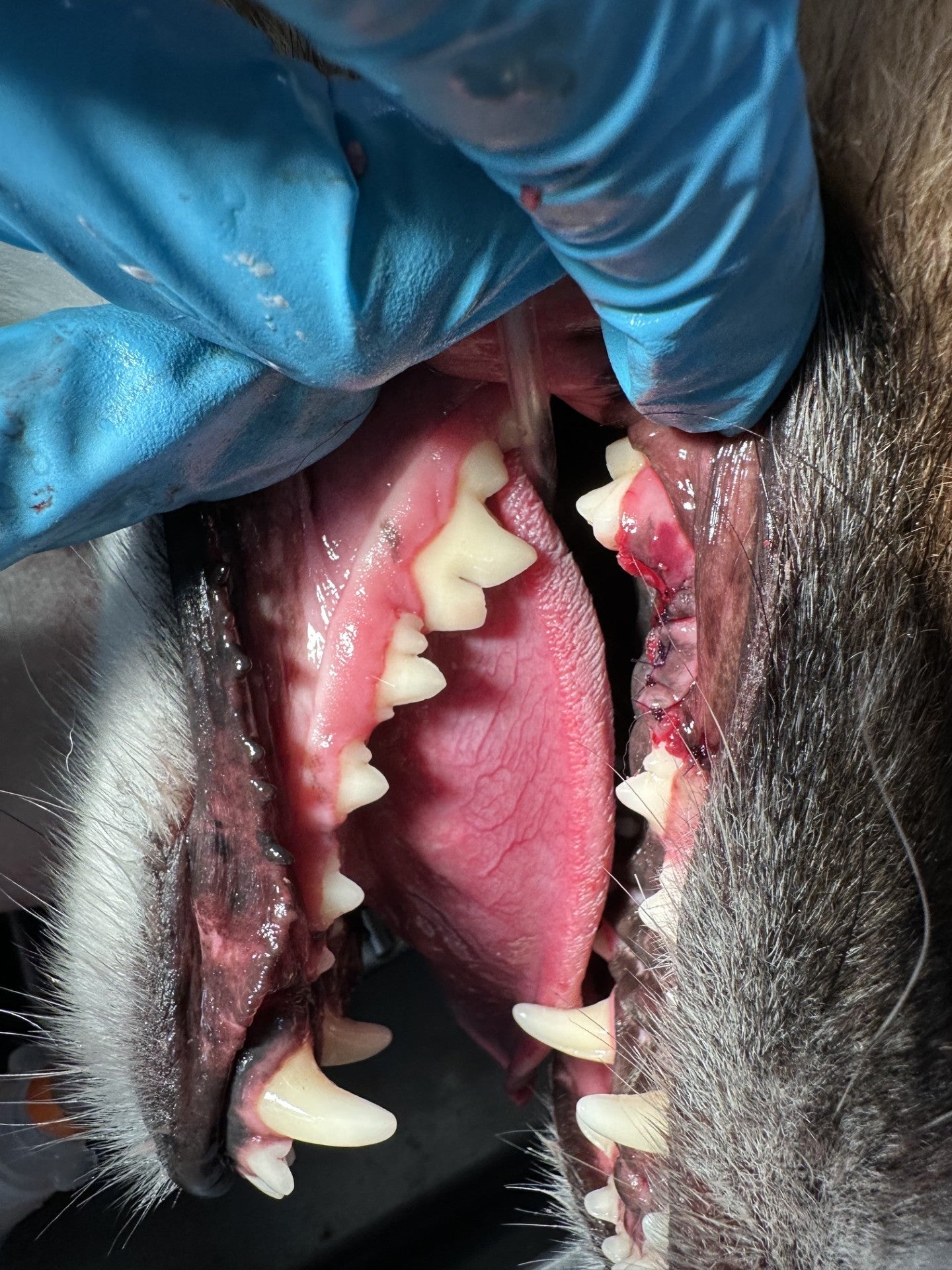
Post-broken tooth removal